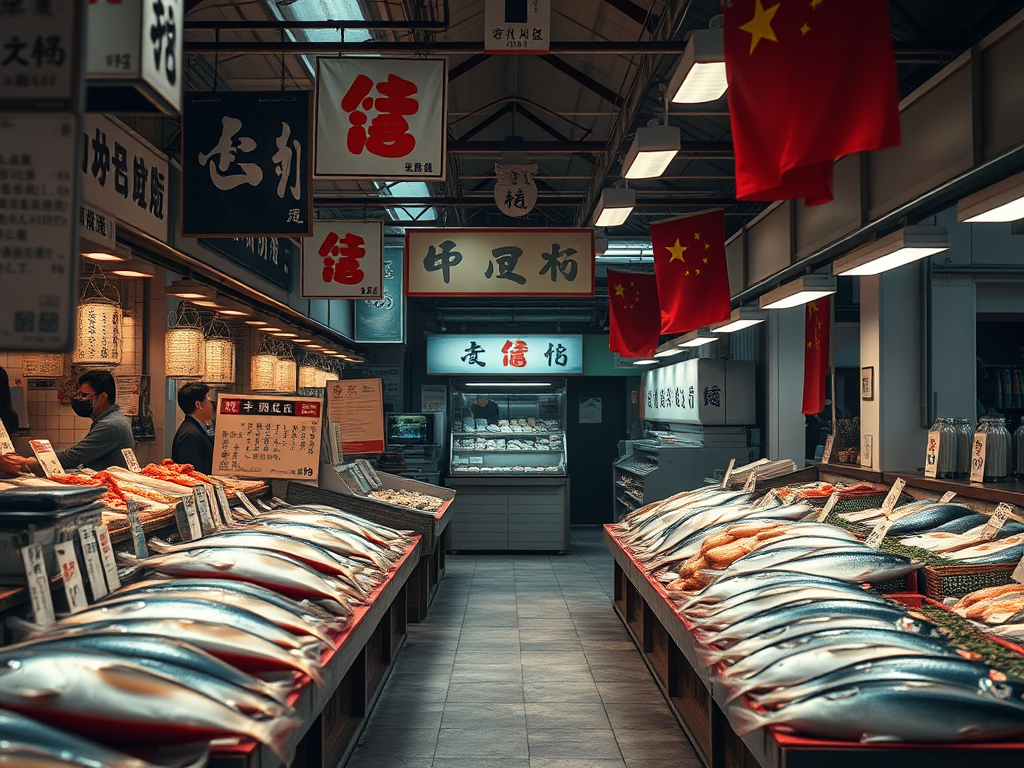
CHINA BANS SEAFOOD FROM JAPAN
Context
In August 2023, in response to the release of water from the damaged Fukushima nuclear power station, China announced an import ban on all Japanese seafood, with the Chinese customs agency citing food safety concerns and stating: “The ocean is the common property of all humanity, and forcibly starting the discharge of Fukushima’s nuclear wastewater into the ocean is an extremely selfish and irresponsible act that ignores international public interests,” Beijing’s foreign ministry said in a statement.
The ban was more geographically comprehensive than at the time of the nuclear incident in 2011, but more limited in product scope. In 2011, China banned all food and agriculture products from 10 of the 47 prefectures of Japan. The 2023 ban only related to seafood, but covered all prefectures. Additionally, the ban only impacted Japanese operators, as Chinese boats operating in the same waters were not subject to the ban.
Japanese commentators claimed that the measure was economic coercion rather than a legitimate health measure, and have pointed out that the release of water was approved by the Atomic Energy Agency. For example, one commentator, directly alleging the ban to be economic coercion, pointed to the following rationale for the ban:
“Many critics argue that China’s actions [the seafood ban] constitute economic coercion that leverages disinformation. It has been suggested that their true strategic objectives are a fourfold division: between Japan and the international community, within public opinion in Japan, within public opinion in South Korea, and in the relations between Japan, the U.S., and South Korea. Moreover, some argue that China’s actions are aimed at venting the dissatisfaction accumulated within China owing to its economic downturn.”
Responses
Media reported that Taiwan and the United States supported Japanese seafood exporters, with one outlet noting
[T]he Taipei Economic and Cultural Representative Office in Japan distributed processed scallops from Hokkaido at the national day party in October 2023, and at the end of October 2023, the U.S. forces announced its support for the purchase of Japanese marine products. In particular, the support by Taipei was meant to be a repayment for Japan’s support for the purchase of Taiwanese pineapples when China banned imports of pineapples from Taiwan in 2021.
The same article
Status
As of September 2024, the ban remains in place.
Reference List & Further Reading
Kuno, Arata, “How to Manage Economic Coercion: Neutralizing Its Impact through Diversification of Sales Channels and Procurement Sources” (2023) The Japan Forum on International Relations, online at https://www.jfir.or.jp/en/commentary/4250/
Ferguson, Victor and Lim, Darren, (2024) “Yesterday’s stick, today’s carrot? China’s removal of the Japan seafood ban” The Interpreter (September 26), online at https://www.lowyinstitute.org/the-interpreter/yesterday-s-stick-today-s-carrot-china-s-removal-japan-seafood-ban
“China, Japan face growing tensions over fishing rights” ( 2024) National Fisherman (August 21) online at https://www.nationalfisherman.com/west-coast-pacific/china-japan-face-growing-tensions-over-fishing-rights#:~:text=Despite%20China’s%20ban%20on%20Japanese,frustration%20and%20fear%20as%20their
“China does a U-turn on Japanese fish, agrees to ‘gradually resume’ imports” (2024) PIME Asia News, online at https://www.asianews.it/news-en/China-does-a-U-turn-on-Japanese-fish,-agrees-to-‘gradually-resume’-imports-61550.html#google_vignette
Leave a Reply