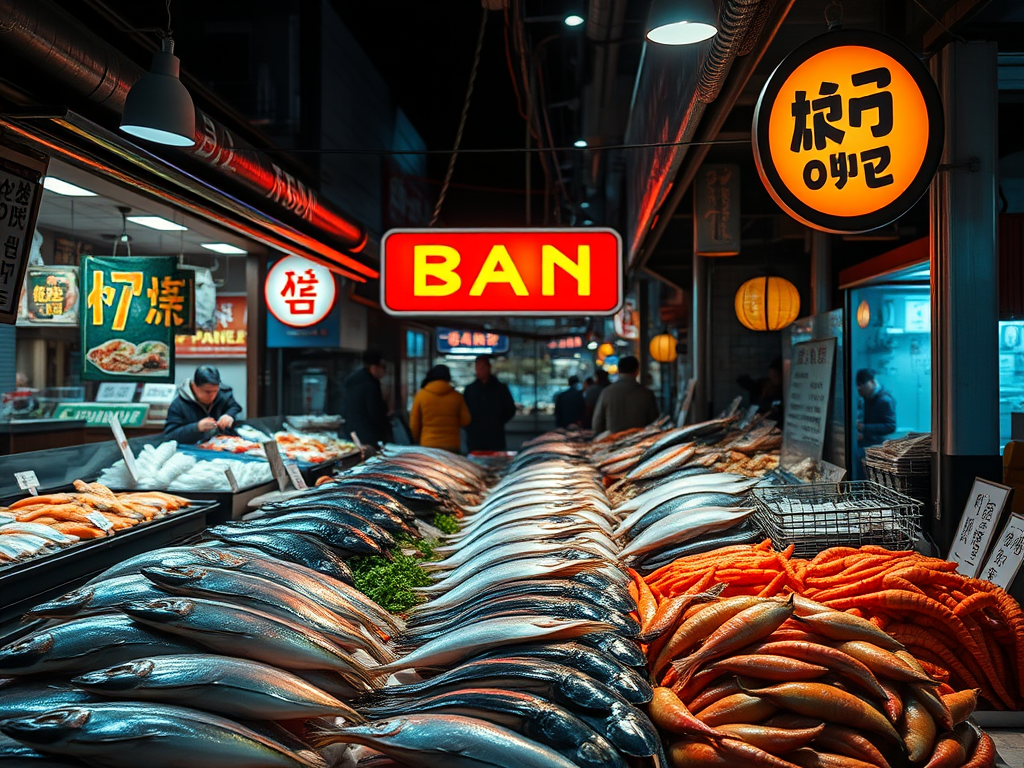
SOUTH KOREA BANS SEAFOOD FROM JAPAN
Context
In 2013, in response to the damaged Fukushima nuclear power station, Korea placed an an import ban on all Japanese seafood, from Fukushima and seven nearby prefectures.
Japanese commentators claimed that the measure was economic coercion rather than a legitimate health measure, and have pointed out that the release of water was approved by the Atomic Energy Agency. For example, one commentator, directly alleging the ban to be economic coercion, pointed to the following rationale for the ban:
“Many critics argue that China’s actions [the seafood ban] constitute economic coercion that leverages disinformation. It has been suggested that their true strategic objectives are a fourfold division: between Japan and the international community, within public opinion in Japan, within public opinion in South Korea, and in the relations between Japan, the U.S., and South Korea. Moreover, some argue that China’s actions are aimed at venting the dissatisfaction accumulated within China owing to its economic downturn.”
WTO Dispute
In May 2015, Japan requested consultations with Korea at the WTO, challenging both the import ban as well as a lack of transparency on Korea’s imposition of additional SPS measures, and a challenge to the measures themselves. A summary of the dispute is available on the WTO Website. The WTO Panel Decision in February 2018 agreed that the transparency obligations had not been met by Korea, and also found that the ongoing ban was inconsistent with WTO principles (although it was not at the time it was first applied). It also foudn that the addiitional testing requirements were more onerous than necessary from the time at which they were imposed. Korea appealed the decision to the Appellate Body in April 2018, and reversed the Panel’s findings in respect of several aspects of the claim, and substituted its own reasoning in respect of several others, a decision that was criticised by Japan through its ambassador in Geneva, Junichi Ihara.
Impact
In October 2023, Korean media reported that Japanese seafood was still entering South Korea despite the ban, due to the ban being primarily on fresh seafood. According to the report, over 80% of the imported processed seafood was from Fukushima Prefecture.
Update
In January 2024, media reported that North Korea had been implicated in spreading anti-Japanese sentiment in South Korea. One article noted “among them were those who were instructed to spread disinformation on treated water from the Fukushima NPP, such as “the appearance of a monster fish off the coast of Fukushima” and “births of deformed babies” through SNS sites.”.
Reference List & Further Reading
Hyo-jin, L, (2023) “Korea’s import ban on Fukushima seafood faces hurdles”
Kuno, Arata, “How to Manage Economic Coercion: Neutralizing Its Impact through Diversification of Sales Channels and Procurement Sources” (2023) The Japan Forum on International Relations, online at https://www.jfir.or.jp/en/commentary/4250/
Ferguson, Victor and Lim, Darren, (2024) “Yesterday’s stick, today’s carrot? China’s removal of the Japan seafood ban” The Interpreter (September 26), online at https://www.lowyinstitute.org/the-interpreter/yesterday-s-stick-today-s-carrot-china-s-removal-japan-seafood-ban
“China, Japan face growing tensions over fishing rights” ( 2024) National Fisherman (August 21) online at https://www.nationalfisherman.com/west-coast-pacific/china-japan-face-growing-tensions-over-fishing-rights#:~:text=Despite%20China’s%20ban%20on%20Japanese,frustration%20and%20fear%20as%20their
“China does a U-turn on Japanese fish, agrees to ‘gradually resume’ imports” (2024) PIME Asia News, online at https://www.asianews.it/news-en/China-does-a-U-turn-on-Japanese-fish,-agrees-to-‘gradually-resume’-imports-61550.html#google_vignette
Leave a Reply