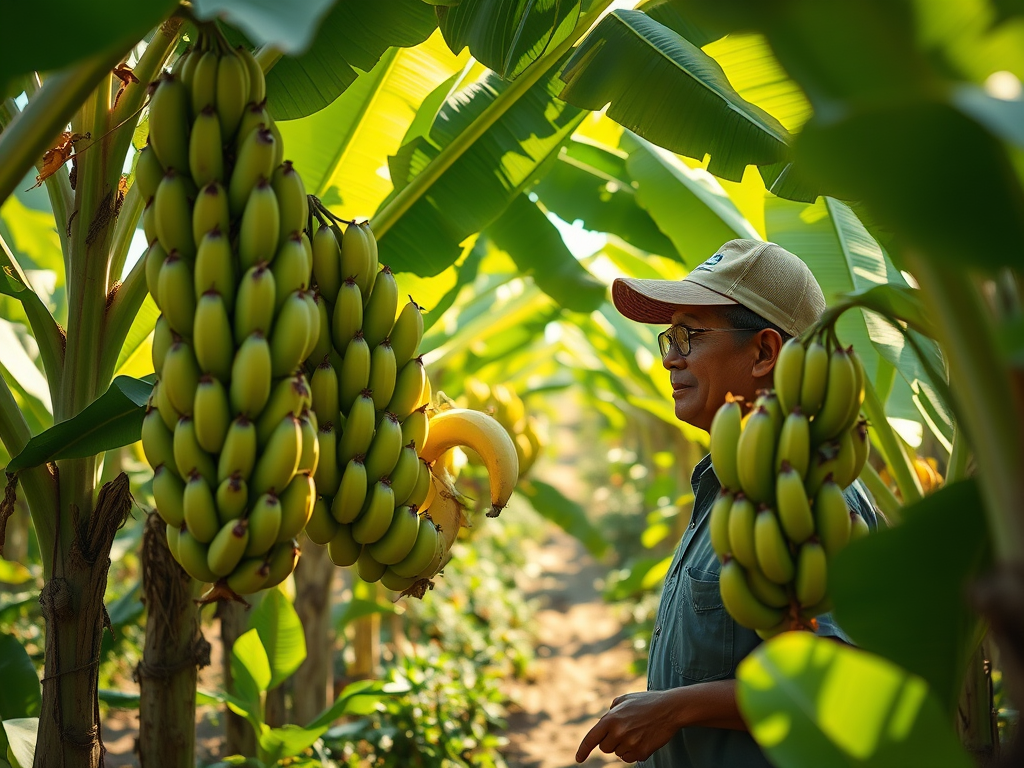
China restricts imports of bananas from the Philippines in March 2012.
Context
In March 2012, China suspended the banana export permit for the Philippine firm Sumifru Corporation, and imposed a new, more restrictive quarantine system on all other bananas from the Philippines. The stated reason for this measure was a claim that quarantine officials had discovered pests – a species named Aonidiella comperei Mckenzie – in a Sumifru Corporation shipment during inspections in Shenzen. The broader, implied context for this conflict was a maritime territorial dispute between Beijing and Manilla relating to the South China Sea’s Scarborough Shoal.
Impact
This measure impacted agriculture – specifically bananas. After coconuts, bananas were reportedly the Philippines second biggest agricultural export commodity at the time of this case – and China was the Philippines’ second largest export market for bananas after Japan. One local newspaper report claimed that, between March and May 2012, around US$16 million of bananas had spoiled while waiting for inspections during the enhanced quarantine process in China. The head of Philippine banana industry group Pilipino Banana Growers and Exporters Association, Stephen Antig, suggested that as many as 200,000 jobs could be lost as a result of the measures.
Responses
(i) Philippines Industry
A Filipino banana grower, Josephine Capagcuan, spoke to press about the impact of the restrictions after China stopped buying their fruit, saying that “[w]e’re having a hard time to finance our area anymore especially the farm inputs and also our labourers. We can’t pay their salaries for them.” The President of the Kidapawan Chamber of Commerce and Industry, Ramon Floresta, called on the President of the Philippines, Benigno Aquino, “to immediately intervene and fast-track the settlement of the dispute.”
The head of Philippine banana industry group Pilipino Banana Growers and Exporters Association, Stephen Antig, suggested that as many as 200,000 jobs could be lost as a result of the measures and told local press that “[w]e (the association) recently held a meeting and shared the same apprehension that we may lose the valuable market in China as a result of the dispute over the shoal.”
(ii) Philippines Government
The head of the Department of Agriculture’s Bureau of Plant Industry, Clarito Barron, told press that they were seeking answers from Beijing about this case, noting that there had been no similar issues with other export destinations, Japan and South Korea, for the Philippines’ bananas. Barron also identified a number of alternative export markets being investigated, ranging from Saudi Arabia to the UK.
Government officials in Manilla largely avoided publicly linking this case to geopolitical tensions with Beijing. A government delegation was sent from Manilla to China to discuss China’s expected standards and procedures for banana imports.
A senior official in the Philippines government – Economic Planning Secretary Arsenio Balisacan – later reiterated to press that Manilla would need to identify and diversify its banana export markets in response to this measure (together with reduced tourism). Balisacan said that “[a]s of now, we are likely to see modest effects (on the economy), but we need to intensify our efforts to diversify our trade with other countries”, before adding that “whether or not this event with China occurred, we should have been diversifying our exports.”
In July 2012, The Philippines’ embassy in Beijing issued a public statement refuting suggestions that there was a de facto ban on banana exports to China. The statement said that “to date, there has never been any suspension by the Chinese government of the entry of bananas from the Philippines for as long as these pass the food and safety standards and requirement of the People’s Republic of China.”
(iii) Philippines Civil Society
Civil society groups in the Philippines engaged in street protests expressing concern that the Government of The Philippines was largely downplaying the significance of geopolitics in the dispute, while Philippine industry groups were doing the opposite in highlighting the geopolitical context. For example, Pilipino Banana Growers and Exporters Association President Stephen Antig told local press that “[w]e (the association) recently held a meeting and shared the same apprehension that we may lose the valuable market in China as a result of the dispute over the shoal.”
(iv) Chinese Government
The Chinese government continued to maintain that the restrictions on the Philippines’ banana exports were purely the result of strengthened inspection and quarantine measures. However, in late July 2012, China’s Ambassador to ASEAN, Tong Xiaolong, made it clear that if the Philippine government persisted in its course of action regarding the Scarborough Shoal incident, China-Philippines bilateral relations, including trade and economic ties, would be damaged.
(v) Other states’ responses
Attempts to diversify The Philippines banana exports to the US market in 2013 were ultimately deemed unviable, due to the geographic distances involved.
Status
In June 2012, Philippine President Aquino told press that the country’s banana exports were once again being accepted by China. In July 2012, The Philippines’ embassy in Beijing issued a public statement refuting suggestions that there was a de facto ban on banana exports to China. The statement said that “to date, there has never been any suspension by the Chinese government of the entry of bananas from the Philippines for as long as these pass the food and safety standards and requirement of the People’s Republic of China.” Despite expanded inspections, reporting in late 2012 cited data as suggesting that in 2012 Chinese imports of bananas from The Philippines were on track to grow year on year by approximately 5%. Subsequently, in 2017, exports of Philippine bananas to China massively increased, following Manilla’s reported geopolitical realignment away from Washington towards Beijing.
References & Further Information
AFP. 2012. “Philippines works to heal banana split with China.” Emirates 24/7. May 13. Available at: https://www.emirates247.com/news/world/philippines-works-to-heal-banana-split-with-china-2012-05-13-1.458515
CNTV. 2012. “Philippines Government Representatives Head to China to Discuss Banana Ban.” Beijing Review. May 18. Available at: http://www.bjreview.com.cn/ special/2012-05/18/content_453657.htm
David, E. 2014. “Philippines Not Yet A Viable Source For Bananas For US.” The Invisible Hand. April 10. Available at: https://bizeconreporting.journalism.cuny.edu/ 2014/04/10/philippines-not-yet-a-viable-source-for-bananas-for-us/
Financial Times. 2012. “Philippines vs China: going bananas.” Financial Times. May 11. Available at: https://www.ft.com/content/7f801f57-b7fc-3a54-9634-56a15c41fd3e
Fresh Fruit Portal. 2012. “Philippines looks to new banana markets amid Chinese debacle.” Fresh Fruit Portal. September 27. Available at: https://www.freshfruitportal. com/news/2012/09/27/philippines-looks-to-new-banana-markets-amid-chinese-debacle/
Fruitnet. 2012. “Philippine banana trade with China in doubt.” AsiaFruit. May 15. Available at: https://www.fruitnet.com/asiafruit/philippine-banana-trade-with-china-in-doubt/14251.article
GMA News Online. 2012. “PHL sees banana exports to China growing 5% in 2012.” GMA News Online. November 20. Available at: https://www.gmanetwork.com/news/ money/economy/283068/phl-sees-banana-exports-to-china-growing-5-in-2012/story/
Hey, J. 2012. “China gets strict on Philippine bananas.” AsiaFruit. March 9. Available at: https://www.fruitnet.com/asiafruit/china-gets-strict-on-philippine-bananas/13621.article
Lema, K., M. Mogato, and C. Buckley. 2012. “Philippines seeks new markets amid sea dispute with China”. Reuters. May 17. Available at: https://www.reuters.com/article/ business/philippines-seeks-new-markets-amid-sea-dispute-with-china-idUSLNE84G026/#:~:text=China%20stopped%20a%20shipment%20of,rules%20on%20other%20Philippine%20fruit.\
Peel, M. and G. Ramos. 2017. “Philippine banana bonanza sparks debate on shift to China.” Financial Times. March 14. Available at: https://www.ft.com/ content/3f6df338-056b-11e7-ace0-1ce02ef0def9
Philippine Daily Enquirer. 2012. “No ban of Philippine bananas in China.” Inquirer.Net. July 11. Available at: https://globalnation.inquirer.net/43766/no-ban-of-philippine-bananas-in-china
The American Interest. 2012. “Going Bananas in the South Pacific.” The American Interest. June 13. Available at: https://www.the-american-interest.com/2012/06/12/going-bananas-in-the-south-pacific/
West, K. 2012. “Banana crisis blamed on Philippines-China dispute.” ABC News. June 29. Available at: https://www.abc.net.au/news/2012-06-29/an-banana-exporters-caught-in-philippines-china-dispute/4100422
Tong Xiaoling, Public Diplomacy Advisory Panel, Ministry of Foreign Affairs of the People’s Republic of China. 2012. ‘The Scarborough Shoal incident will harm China-Philippines bilateral relations’ [黄岩岛事件讲损害中菲双边关系] (25 July 2012), available at: http://pdap.mfa.gov.cn/zxdt/201207/t20120725_846309.htm.