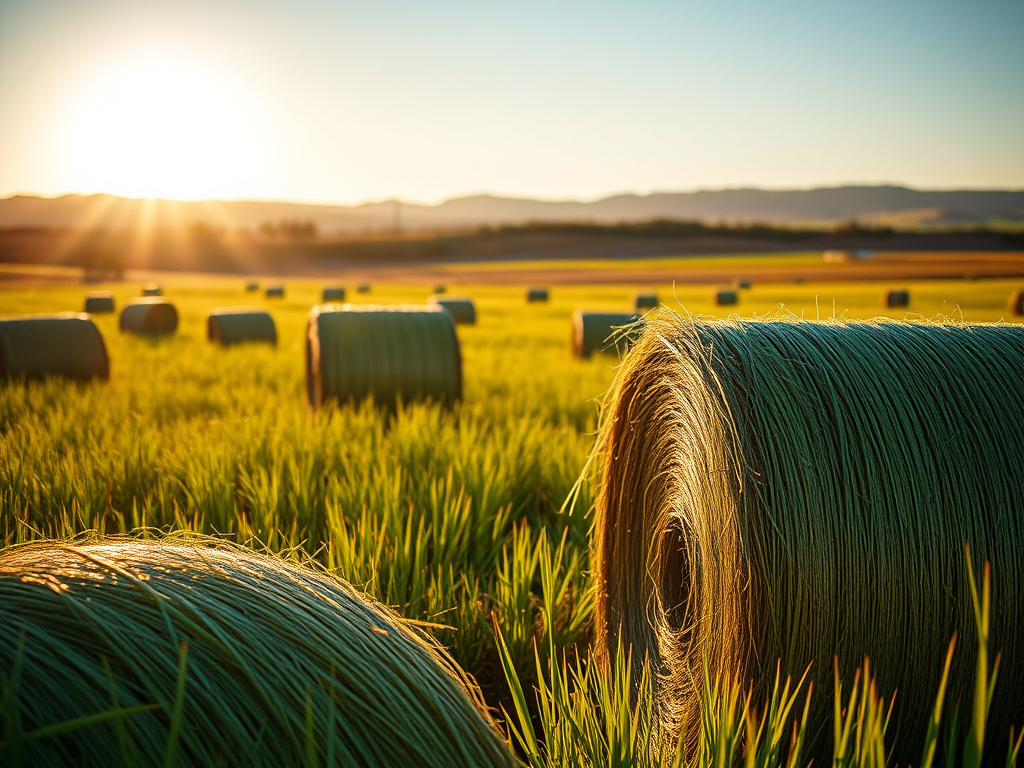
China refuses to renew permits on Australian hay and chaff imports from February 2021.
Context
In March 2021, media reported that around 25 Australian firms selling hay to China had failed to receive their required export permits since the end of February 2021. The Chinese government did not make any official announcements of this move. This instance of Weaponised Trade relates to escalating geopolitical tensions between Canberra and Beijing. Chinese media noted in March 2021 that China-Australia trade relations were on a “downward spiral”.
Impact
Almost half of Australia’s hay and straw exports are produced in Western Australia, and South Australia and Victoria are also major hay and straw producers. Prior to this action, China was annually importing around 350,000 tonnes of Australian hay and straw. During this action, this figure was down to around 60,000 tonnes for the year 2022.
Responses
i) Australian Industry
Export permits in this in industry are reportedly granted for multiple years, and this action did not involve the cancellation of existing permits – only preventing the issuance of new permits. Therefore, not all firms involved in this industry were impacted.
Australia’s largest hay exporter is the firm Gilmac. In March 2021 Gilmac’s managing director, Munro Patchett, acknowledged that Gilmac had not yet been granted a new permit for its operations, but also sought to downplay the likely cause – suggesting that COVID-19 pandemic may have been behind the move. Patchett was quoted in Australian media as saying that “[t]hey (the Chinese government) have a process where [Chinese officials] come out and inspect our facilities and make sure we’re doing the right thing and our hygiene standards are correct and they’re not able to travel out here… Maybe that’s having an impact… Maybe they’re trying to work out how to renew it without doing those sorts of things. We don’t actually know at the moment.” At the same time, Patchett also suggested that if the situation did not soon resolve then Australian farmers should perhaps decide that “[i]nstead of growing large amounts of oaten hay, they (Australian farmers) might grow oaten grain or change to some other crops.”
In the same media report, a further Australian hay farmer, based in Narembeen, Western Australia, said that they expected hay prices to drop by around 20%, but that nevertheless “I won’t react too strongly… I’m not going to plant as much hay. I’ll probably swing a bit over to other cereals if weed control isn’t too much of an issue.”
According to agricultural statistics made by the China Agricultural University, the total hay imports from January to April 2021 was 112,900 tons, a year-on-year decrease of 10%. The report made it clear that such a decrease was caused by the suspension of licences for Australian hay exporters, which was a result of the broader deterioration of China-Australia diplomatic relations.
(ii) Australian Government Responses
The Australian government did not respond to this incident.
[iii] Chinese Government Responses
Although being asked multiple times by Chinese importers in January and February 2021, the Chinese government did non to provide any clear answers on whether Australian hay import permits would be renewed.
(iv) Third Party Responses
US firms may have benefitted from this instance of weaponised trade. US hay exports to China in 2022 increased by 18% compared to 2021, selling $698.8 million to the Chinese market.
Status
In September 2023, the Australian government announced that barriers to its hay exports to China had been dropped. This was part of a broader trend towards the end of China’s Weaponised Trade against Australia, and followed an active diplomatic push by Australian delegations. Australian Trade Minister Don Farrell quoted by press as noting in response that “This is another positive step forward, but there is more work to do”
References & Further Information
Field, E. 2023. “China re-opens trade for Australian hay exports after two-year lockout.” ABC News. September 29. Available at: https://www.abc.net.au/news/2023-09-29/china-trade-tariffs-lifted-for-australian-hay-exports/102916338
Dalian Customs District of the People’s Republic of China. 2021. ‘Response to the permission of Australian hay exports’ [进口澳大利亚燕麦草出口商许可事宜]. January 14. Available at: http://kunming.customs.gov.cn/eportal/ui?pageId=462214&msgDataId=e6949f5335334781841becbed8c9383f
Global Times. 2021. “GT Voice: Complicating trade issues won’t help Canberra’s woes.” Global Times. March 28. Available at: https://www.globaltimes.cn/page/202103/ 1219654.shtml
Government of South Australia. 2023. “Balco’s $100 million hay-day as China trade tariffs ease.” Government of South Australia. November 16. Available at: https://www. premier.sa.gov.au/media-releases/news-items/balcos-$100-million-hay-day-as-china-trade-tariffs-ease
Hobson, P. and D. Patton. 2023. “China drops barriers to Australian hay as trade relations improve.” Reuters. September 28. Available at: https://www.reuters.com/ business/australia-says-exports-hay-china-will-resume-2023-09-28/
National Grass Industry Technology System Office. 2021. ‘Trade statistics of major grass and livestock products from January to April 2021’ [2021年1-4月主要草产品和草食畜产品贸易动态] June 10. Available at: http://www.agdata.cn/newsdata/getagdatanewsdetails-691.html.
Singh, S. 2021. “China stops some Australian hay imports – Global Times.” Reuters. March 26. Available at: https://www.reuters.com/article/business/china-stops-some-australian-hay-imports-global-times-idUSL1N2LO02O/
Tianjin Customs District of the People’s Republic of China. 2021. ‘Response to the term of validity of Australian hay exporters’ licences’ [关于澳大利亚输华燕麦草注册企业有效期的问题] February 23. Available at: http://gdfs.customs.gov.cn/eportal/ui?pageId=433613&msgDataId=f4a1b126229f4b06a1e750b5a2045c24.
Varischetti, B. and J. Prendergast. 2021. “Australian hay growers brace for China hit as export permits lapse amid trade tensions.” ABC News. March 24. Available at: https://www.abc.net.au/news/2021-03-24/hay-china-permits-lapse/100023200
Yin Yeping. 2021a. “Chinese firms confirm halt to some Australian hay imports, seek alternatives.” Global Times. March 25. Available at: https://www.globaltimes.cn/page/ 202103/1219490.shtml?id=11
Yeping, Yin. 2021b. “Hay sector copes with impact of halt in Australian imports.” Global Times. April 20. Available at: https://www.globaltimes.cn/page/202104/1221598.shtml
Yin, Yeping. 2022. “China’s resilient hay market benefits US export; Australian trader eager to follow suit.” Global Times. August 3. Available at: https://www.globaltimes. cn/page/202208/1272143.shtml
3 responses to “HAY AND CHAFF (AUSTRALIA-CHINA)”
[…] your export permit was cancelled without explanation or your shipment of lychees was left rotting in a foreign port for reasons that seem to be […]
[…] your export permit was cancelled without explanation or your shipment of lychees was left rotting in a foreign port for reasons that seem to be […]
[…] 取消且无任何解释 或者您运送的荔枝是 左边腐烂 […]