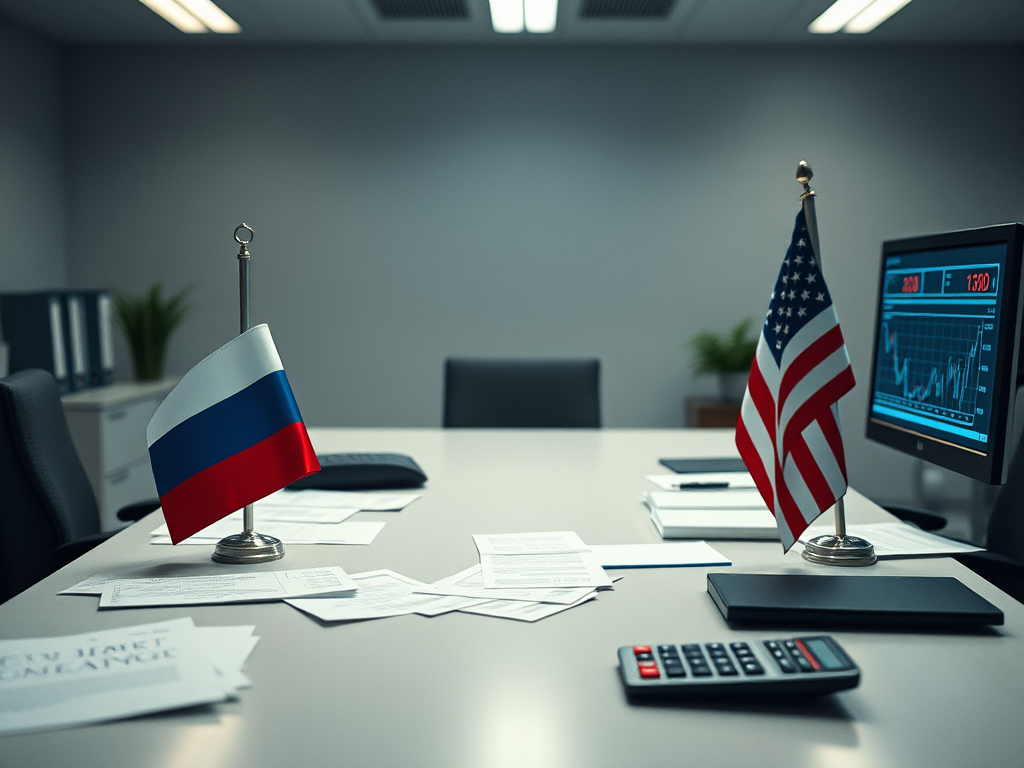
Russia imposes restrictions on the use of US currency and financial services in February/March 2022.
Context
On February 28, 2022, Russian President Vladimir Putin announced a new special decree entailing counter sanctions against the United States and other Western States, officially titled “On Special Economic Measures in connection with the Unfriendly Actions of the United States of America and Other Foreign Countries”. These measures include (but are not limited to) restrictions on usage of foreign currencies for international trade, and bans on loans to non-residents using foreign currencies.
Shortly after this move, two further presidential special decrees were announced. First, on March 1, 2022, a decree entitled “On Additional Temporary Economic Measures To Ensure the Financial Stability of the Russian Federation” was issued, placing limitations on financial transactions with the US and other Western-aligned states – including the issuance of Ruble-based loans and transfers of ownership title. Second, on March 4, a decree entitled “On interim procedures for the fulfilment of corporate finance obligations towards certain foreign creditors” was issued, that included measures putting limits upon issuance of dividends to US and other Western shareholders.
An extensive list of the specific measures entailed in these special decrees has been compiled by the law firm White & Case LLP.
These measures were framed as retaliation for major Western sanctions imposed on Moscow following the invasion of Ukraine in February 2022.
Impact
International media reports have not indicated that these measures had any major impact upon the United States or other Western states.
Responses
i) United States and other Western Government Responses
There is little evidence of United States officials responding to these specific economic measures. In February and March 2022 the speeches and statements issued by Western leaders were instead focused directly on condemning the Russian invasion of Ukraine, and on the Western sanctions imposed on Russia. For example, the US Department of State stated that “The United States, along with its allies and partners, works to ensure the Russian Federation and the Lukashenka regime in Belarus pay a severe economic and diplomatic price for Russia’s aggression against Ukraine.”
(ii) Russian Responses
In mid-March, 2022, the Russian government followed up on these economic measures with diplomatic measures, in the form of a travel ban to Russia against multiple US officials – including President Joseph Biden, Secretary of State Antony Blinken, and Defense Secretary Lloyd Austin. Announcing the move, the Kremlin issued a statement that called these diplomatic sanctions “an inevitable consequence of the extremely Russophobic course taken by the current US Administration, which, in a desperate attempt to maintain American hegemony, has relied, discarding all decency, on the frontal constricting of Russia.” However, this move (later expanded in September 2022) was framed in Western media as “largely symbolic” due to the unlikelihood of these figures choosing to travel to Russia amid the ongoing conflict in Ukraine.
Status
At time of writing (September 2024) these measures appear to still be in force, as the conflict in Ukraine continues.
Reference list
Biden, J. 2022. “Remarks by President Biden on Russia’s Unprovoked and Unjustified Attack on Ukraine.” The White House. February 24. Available at: https://www.whitehouse.gov/briefing-room/speeches-remarks/2022/02/24/remarks-by-president-biden-on-russias-unprovoked-and-unjustified-attack-on-ukraine/
Bychkov, A. and V. Efremov. 2022. “New Russian Presidential Decree imposes new restrictions on distribution of profits and introduces certain clarifications to the existing limitations.” Baker McKenzie. May 5. Available at: https://sanctionsnews. bakermckenzie.com/new-russian-presidential-decree-imposes-new-restrictions-on-distribution-of-profits-and-introduces-certain-clarifications-to-the-existing-limitations/
Fishman, E. and C. Miller. 2022. “The New Russian Sanctions Playbook.” Foreign Affairs. February 28. Available at: https://www.foreignaffairs.com/articles/russia-fsu/2022-02-28/new-russian-sanctions-playbook
Kovalenko, D., I. Blagopoluchnaya, R.F. Marchant, and S. Chapaev. 2022. “Russia Restricts Transactions With Nationals of Sanctioning Countries and Further Limits Transfers of Funds Abroad.” Skadden. March 2. Available at: https://www.skadden.com/insights/publications/2022/03/russia-restricts-transactions-with-sanctioning
Nikitina, N. and E. Logvinova. 2022. “Special Economic Measures Have Been Adopted.” White Case. March 11. Available at: https://www.whitecase.com/insight-alert/special-economic-measures-have-been-adopted
Semenikhina, V. 2022. “Update: Russia Adopts Special Decree on Countermeasures.” Morgan Lewis. February 28. Available at: https://www.morganlewis.com/pubs/2022/ 02/update-russia-adopts-special-decree-on-countermeasures
The Ministry of Foreign Affairs of the Russian Federation. “Foreign Ministry statement on personal sanctions against US citizens.” The Ministry of Foreign Affairs of the Russian Federation. September 5. Available at: https://www.mid.ru/en/foreign_policy/news/ 1828611/
US Department of State. 2024. “How the United States Is Holding Russia and Belarus to Account.” US Department of State. April 15. Available at: https://www.state.gov/ holding-russia-and-belarus-to-account/
Vazquez, M. 2022. “Russia issues sanctions against Biden and a long list of US officials and political figures.” CNN. March 15. Available at: https://edition.cnn.com/2022/ 03/15/politics/biden-us-officials-russia-sanctions/index.html