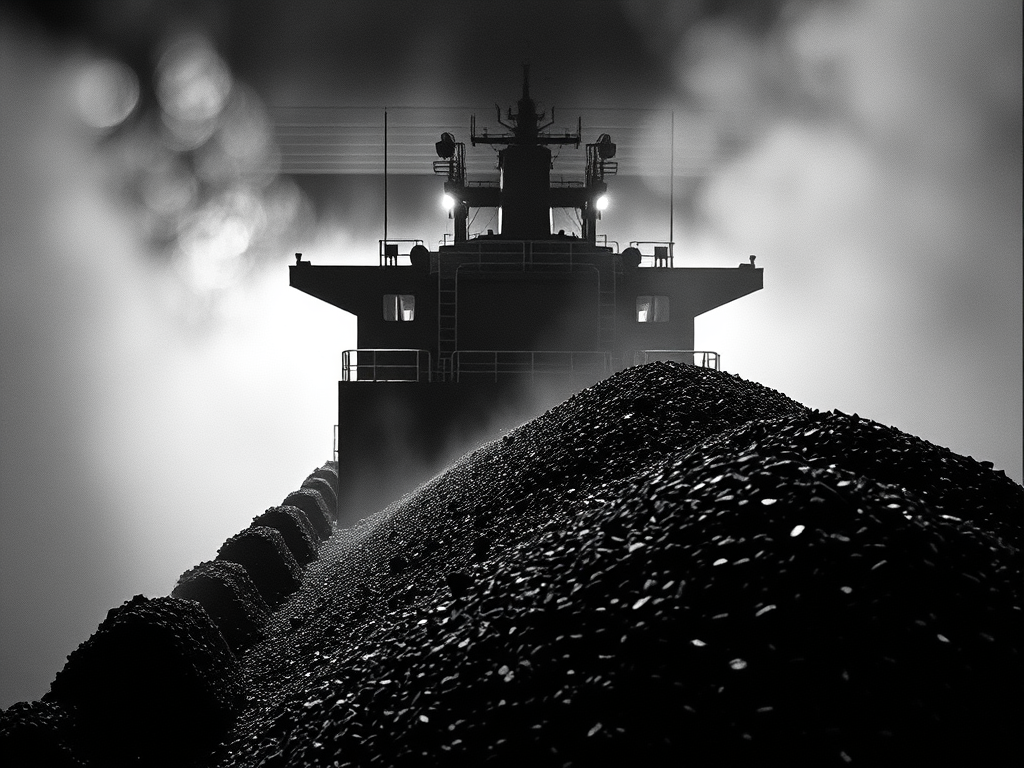
China imposes unofficial ban on Australian coal imports in 2020
Context
In mid-late 2020, Australian coal exports to China began to experience severe delays in customs procedures, with reports of upwards of 50 Australian shipments left queuing off the coast of Chinese ports. On 13 October 2020, the Chinese Ministry of Foreign Affairs objected to the proposition that China’s ban on Australian coal was a retaliation against Australia. In November 2020, the Chinese government claimed that these delays were due to problems with “environmental quality”. A spokesperson for the Chinese foreign ministry, Zhao Lijian, told reporters that Beijing’s “analysis on the safety and quality of imported coal and discovered imported coal not meeting environmental standards is relatively common”.
However, industry sources suggested that Chinese firms importing coal were given unofficial instructions from Beijing to seek alternative sources. In December 2020, Chinese state media appeared to indirectly confirm an unofficial ban on Chinese imports of Australian coal, in an article in the Global Times which claimed that the motivation was a desire to stabilise coal prices. (webcrawler archive link) That article included a quote from the Director of the Institute of Energy Economics, stating:
“China’s major coal import source countries used to be Australia, Indonesia, Russia and Mongolia. Since Mongolia has a geographic advantage that allows lower transportation costs than any other exporters, it could take a large share from Australian coal, as the relationship between China and Australia has been deteriorating and Australia is gradually losing the Chinese market. Domestic suppliers can also grab some market share,”
The Guardian reported, around that time, that “the National Development and Reform Commission met 10 major power companies on the weekend and granted approval for them to import coal without clearance restrictions, except for Australia.” It is now evident that the coal measures were interrelated to an official statement made by the commission in May 2021 emphasising an indefinite suspension of all activities under the China-Australia Strategic Economic Dialogue mechanism.
Notably, these Weaponised Trade measures came at the same time as a major deterioration of bilateral ties between Beijing and Canberra, exacerbated by the Australian federal government’s calls for an inquiry into the origins of COVID-19.
Impact
Australia’s coal exports to China were reportedly worth $13.7 billion in 2019. According to Reuters, immediately prior to the imposition of this measure, Beijing imported 8.68 million tonnes of Australian coal in July 2020 – making it China’s single greatest source of the commodity.
Analysis by Reuters in July 2022 claimed that any end to the unofficial ban would have little impact on trade levels, as “Australian coal, both thermal and coking, is too expensive for Chinese utilities and steel makers to consider buying”, and therefore “the end result doesn’t really change, as Chinese buyers (would) shun Australian fuel, but now based on price not politics.”
A Reuters commentator in May 2024 argued: that the ban ” was a failure from a Chinese perspective, as it led to higher prices for all grades of thermal coal in Asia, while Australia was able to find other buyers, mainly India, for its exports. A further point is that while Australia’s exports to China have been averaging above 6 million tons a month for the past year, they are still below the levels that prevailed prior to the unofficial ban in 2020.”
Responses
(i) Australian Industry Responses
Reporting suggests that the Australian coal industry was largely successful in rerouting its coal exports to alternative markets – and therefore negative impacts on the industry were limited. One industry analysis noted that, subsequent to this instance of Weaponised Trade, “[m]any other Asian markets – such as India, Japan, South Korea and Taiwan – have witnessed sharp rises in Australian coal inflows.”
(ii) Australian Government Responses
Initially, Australia’s Morrison government attempted to downplay the possibility that delays to Australia’s coal exports were unusual. In October 2020, Australian Prime Minister Scott Morrison told press that “[t]hey (China) do have their own coal industry and it is not uncommon that from time to time the Chinese Government will have domestic quotas to support local production and local jobs. . . That is not a new thing.” In November 2020 Australia’s Commonwealth Government called reports of prolonged delays to Australian coal shipments “deeply troubling”. And after the indirect confirmation of the ban in December 2020, Prime Minister Morrison called the move “a bad outcome for the trading relationship between Australia and China, that both countries benefit from.”
(iii) Chinese Industry Responses
The Global Times quoted a manager of Mitsubishi Corp (China) Co, “that the company stopped importing coal from Australia two years ago because of worsening relations between China and Australia.” The same article reported that some Chinese industry saw the move as a positive way of encouraging carbon reduction and decreasing reliance on coal.
(Iv) Third Party Responses
Indonesia, Mongolia, and Russia each increased their coal exports to China, attempting to fill the gap left by this measure. In 2021 China nevertheless experienced power shortages, though state media publicly denied that this was related to the “ban on Australian coal”.
Status
In January 2023 Beijing partially lifted restrictions on Australian coal imports, allowing four of its firms to resume their trade with Australian coal producers – with reports suggesting that Australian coal was still price competitive. By March 2023 Beijing had removed all restrictions, in the context of improving bilateral ties between Canberra and Beijing under Australia’s new Albanese government, elected in 2022.
References & Further Information
ABC News. “China’s alleged ban on Australian coal imports a ‘lose-lose’ situation, Prime Minister says.” ABC News. December 15. Available at: https://www.abc.net.au/ news/2020-12-15/scott-morrison-china-trade-tension-coal-bans/12984322
Birtles, B. 2020. “China claims ‘quality’ problem with Australian coal as $700 million worth sits idle off ports.” ABC News. November 26. Available at: https://www. abc.net.au/news/2020-11-26/china-claims-quality-problem-with-australian-coal/12921354
Gailberger, J. 2020. “Australia demands answers as Global Times confirms Aussie coal import baN.” News.com.au. December 15. Available at: https://www.news.com.au/ finance/business/mining/australia-demands-answers-as-global-times-confirms-aussie-coal-import-ban/news-story/a06c4a744bef42835fe6467e4f9ded10
Gailberger, J. and A. Raphael. “China’s latest target: Australian coal imports.” The Australian. October 13. Available at: https://www.theaustralian.com.au/breaking-news/chinas-latest-target-australian-coal-imports/news-story/dc603893798f4030a34fd157253038e3
Karp, Paul. 2020. “China formalises cut to Australian coal imports, state media reports.” The Guardian. December 15. Available at https://www.theguardian.com/australia-news/2020/dec/14/china-formalises-cut-to-australias-coal-imports-state-media-reports
Lei, T. 2020. “Australia’s coal import ratio is only 2%, nothing to do with China’s temporary power shortages.” Global Times. December 19. Available at: https://www. globaltimes.cn/content/1210355.shtml
Millington, B. 2020. “China’s unofficial ban on Australian coal sees exports halt as trade war rages.” ABC News. December 9. Available at: https://www.abc.net.au/news/2020-12-09/chinas-unofficial-ban-on-australian-coal-sees-exports-cease/12960254
Ministry of Foreign Affairs of the PRC. 2020. ‘Spokesman for the Ministry of Foreign Affairs, Zhao Lijian, held a regular press conference on 13 October 2020’ [2020年10月13日外交部发言人赵立坚主持例行记者会]. October 13. available at: https://www.mfa.gov.cn/wjdt_674879/zcjd/202010/t20201013_7943825.shtml.
National Development and Reform Commission. 2021. ‘Statement on the Indefinite Suspension of All Activities under the China-Australia Strategic Economic Dialogue Mechanism’ [关于无限期暂停中澳战略经济对话机制下一切活动的声明]. May 6. Available at: https://www.ndrc.gov.cn/xwdt/xwfb/202105/t20210506_1279171.html.
Packham, C. 2020. “Australia says world needs to know origins of COVID-19.” Reuters. September 26. Available at: https://www.reuters.com/article/world/australia-says-world-needs-to-know-origins-of-covid-19-idUSKCN26H00S/
Pande, S. and S. Mohanty. 2021. “Amid China vacuum, Australian coal finds new homes in India, Japan.” SP Global. December 16. Available at: https://www.spglobal.com/ commodityinsights/en/market-insights/blogs/coal/121621-china-coal-australia-india-japan
Reuters. 2023. “China reportedly gives green light to limited Australian coal imports after two-year ban.” ABC News. January 5. Available at: https://www.abc.net.au/news/ 2023-01-05/china-gives-green-light-to-australian-coal-imports/101829430
Russell, C. 2022. “China’s mooted end to Australian coal ban will have zero market impact.” Reuters. July 25. Available at: https://www.reuters.com/markets/ commodities/chinas-mooted-end-australian-coal-ban-will-have-zero-market-impact-2022-07-25/
Russell, C. 2024. “China overtakes Japan in April as Australia’s top coal market.” Reuters. May 1. Available at: https://www.mining.com/web/column-china-overtakes-japan-in-april-as-australias-top-coal-market/
Uren, D. 2023. “Why China’s coercion of Australia failed.” The Strategist. April 27. Available at: https://www.aspistrategist.org.au/why-chinas-coercion-of-australia-failed/
Xu, M., S. Varadhan, and M. Burton. 2021. “India, Indonesia benefit as China’s ban on Australian coal reshapes trade flows.” Reuters. April 8. Available at: https://www. reuters.com/article/coal-trade/analysis-india-indonesia-benefit-as-chinas-ban-on-australian-coal-reshapes-trade-flows-idUSKBN2BV1GN/