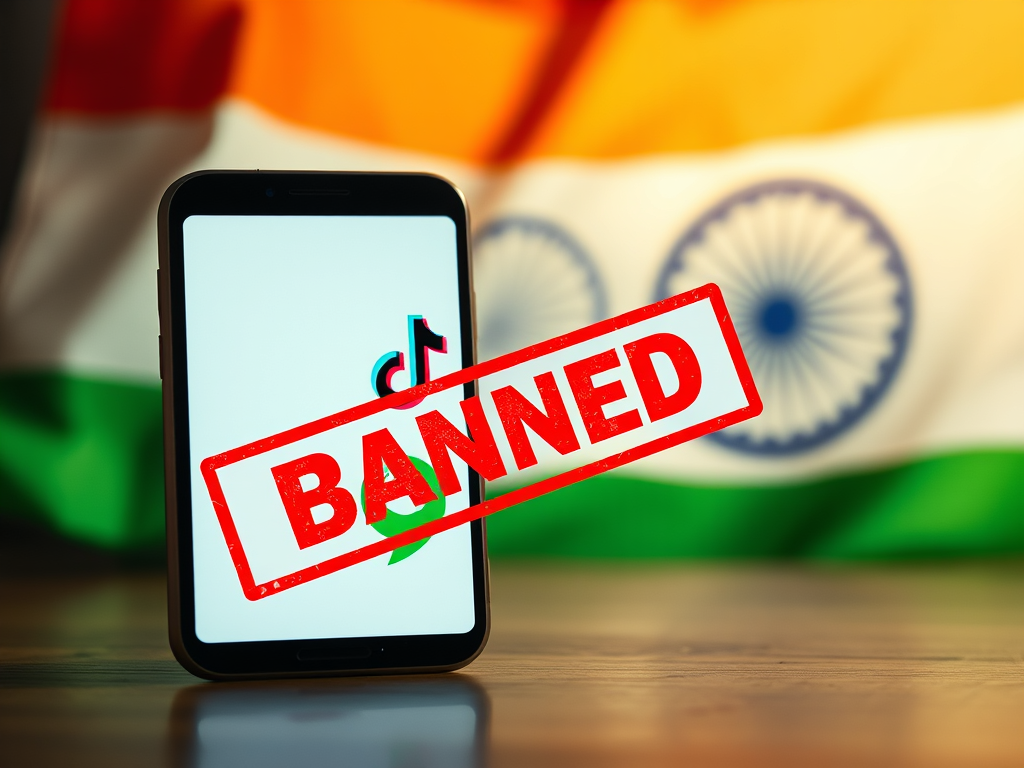
India imposes a ban on Chinese mobile apps in June 2020.
Context
On June 29, 2020, the Indian government’s Ministry of Electronics and IT announced a ban on 59 Chinese-owned mobile applications – including well-known social media platforms TikTok and WeChat. In a statement, the ministry claimed that the impacted mobile apps “engaged in activities which is prejudicial to sovereignty and integrity of India, defence of India, security of state and public order.” Subsequently, in September 2020 a second round of bans was announced on Chinese tech companies’ mobile apps – with a further 118 added to the list. The bans were made permanent in January 2021. Other reports have suggested that as many as 500 Chinese mobile apps have been banned in India as of April 2024.
These bans were justified in reference to concerns around data security and privacy. However, the broader political context here is military border skirmishes between China and India earlier in June 2020, which left at least 20 Indian soldiers dead – an explanation for the ban echoed by Chinese media sources.
Impact
This measure impacted technology/media, specifically mobile applications. The list of 59 apps initially targeted through this measure are below (see below – screenshot from the original Ministry of Electronics and IT announcement).

Responses
i) Chinese government and industry responses.
In June and September 2020, the spokesperson of the Chinese Ministry of Commerce emphasised that India had abused ‘national security’ concerns and imposed discriminatory restriction measures on Chinese companies, which were a severe contravention of WTO rules. However, while the Chinese government has repeatedly “condemned” these measures, it did not seek to retaliate. Analysis has suggested that this is because India does not have a major tech industry in China that would be suitable for reciprocal measures.
Major Chinese tech companies behind the apps did not challenge the decision in India – although India was a major market for TikTok – having achieved around 191 million downloads by the end of 2019. TikTok India head, Nikhil Ghandi, issued a statement on Twitter that acknowledged the ban, and defended the company’s business practices, saying that “[w]e place the highest importance on user privacy”.
(ii) Other states’ government and industry responses.
YouTube Shorts and Instagram were reportedly the main beneficiaries of this ban in terms of market share. International media reports largely focused on the ban of TikTok, and this may have influenced the US’ decision to subsequently place a similar ban on TikTok. Former US Secretary of State Mike Pompeo reportedly praised India’s decision to ban TikTok.
Status
This case is ongoing and has not resolved. As of the time of writing [February 2025] some Chinese apps have reportedly appeared to resurface on the Apple App Store and Google Play Store in India. However, major apps such as TikTok are still absent.
Reference list
Basu, T. 2020. “India has banned TikTok—plus 58 other Chinese apps.” MIT Technology Review. June 29. Available at: https://www.technologyreview.com/2020/06/ 29/1004616/india-bans-tiktok-plus-58-other-chinese-apps/
Caijing. 2021. ‘Demystifying India’s ban on Chinese mobile apps’ [印度屏蔽中国手机应用始末]. April 19. Available at: https://m.caijing.com.cn/api/show?contentid=4757836
Chawake, A. 2025. Banned Chinese apps like Xender and TanTan are back, but TikTok is still missing. February 13. Available at: https://indianexpress.com/article/technology/tech-news-technology/banned-chinese-apps-xender-tantan-shein-back-tiktok-missing-9829795/
Germain, T. 2024. “The ghosts of India’s TikTok: What happens when a social media app is banned.” BBC News. April 27. Available at: https://www.bbc.com/future/article/ 20240426-the-ghosts-of-indias-tiktok-social-media-ban
Griffiths, J. “Why are China and India fighting over an inhospitable strip of the Himalayas?” CNN. June 18. Available at: https://edition.cnn.com/2020/06/17/ asia/india-china-aksai-chin-himalayas-intl-hnk/index.html
Ministry of Commerce of the People’s Republic of China. 2020. ‘The spokesman of the Ministry of Commerce responded to the incident that India declared to ban 118 mobile apps by China’ [商务部回应印度宣布禁用118款中国App: 严重关切, 坚决反对] September 3. Available at: https://www.gov.cn/xinwen/2020-09/03/content_5540151.htm
Ministry of Electronics and IT. 2020. “Government Bans 59 mobile apps which are prejudicial to sovereignty and integrity of India, defence of India, security of state and public order.” Press Information Bureau, Government of India. June 29. Available at:https://pib.gov.in/PressReleseDetail.aspx?PRID=1635206
Ministry of Foreign Affairs of the People’s Republic of China. 2020. ‘Spokesman for the Ministry of Foreign Affairs, Zhao Lijian, held a regular press conference on 30 June 2020’ [2020年6月30日外交部发言人赵立坚主持例行记者会] June 30. Available at: https://www.mfa.gov.cn/fyrbt_673021/jzhsl_673025/202006/t20200630_5419070.shtml
Singh, K. “India to impose permanent ban on 59 Chinese apps, including TikTok – Indian media.” Reuters. January 26. Available at: https://www.reuters.com/world/china/india-impose-permanent-ban-59-chinese-apps-including-tiktok-indian-media-2021-01-25/
TikTok India. 2020. “An Update.” Twitter. June 30. Available at: https://x.com/TikTok_IN/ status/1277811841364668416?ref_src=twsrc%5Etfw%7Ctwcamp%5Etweetembed%7Ctwterm%5E1277811841364668416%7Ctwgr%5Ecc9469a200a97050d9c20e527a3b999b2d40336f%7Ctwcon%5Es1_&ref_url=https%3A%2F%2Fwww.theverge.com%2F2020%2F6%2F29%2F21307014%2Findia-ban-tiktok-wechat-china-apps
Times of India. 2024. “What happened when Tiktok app was banned in India, Chinese company’s biggest market.” Times of India. April 2. Available at: https://timesofindia. indiatimes.com/technology/tech-news/what-happened-when-tiktok-was-banned-in-india-the-companys-biggest-market/articleshow/108928388.cms
VOA. 2024. “What Happened When India Banned TikTok.” VOA Learning English. April 25. Available at: https://learningenglish.voanews.com/a/what-happened-when-india-banned-tiktok/7583675.html