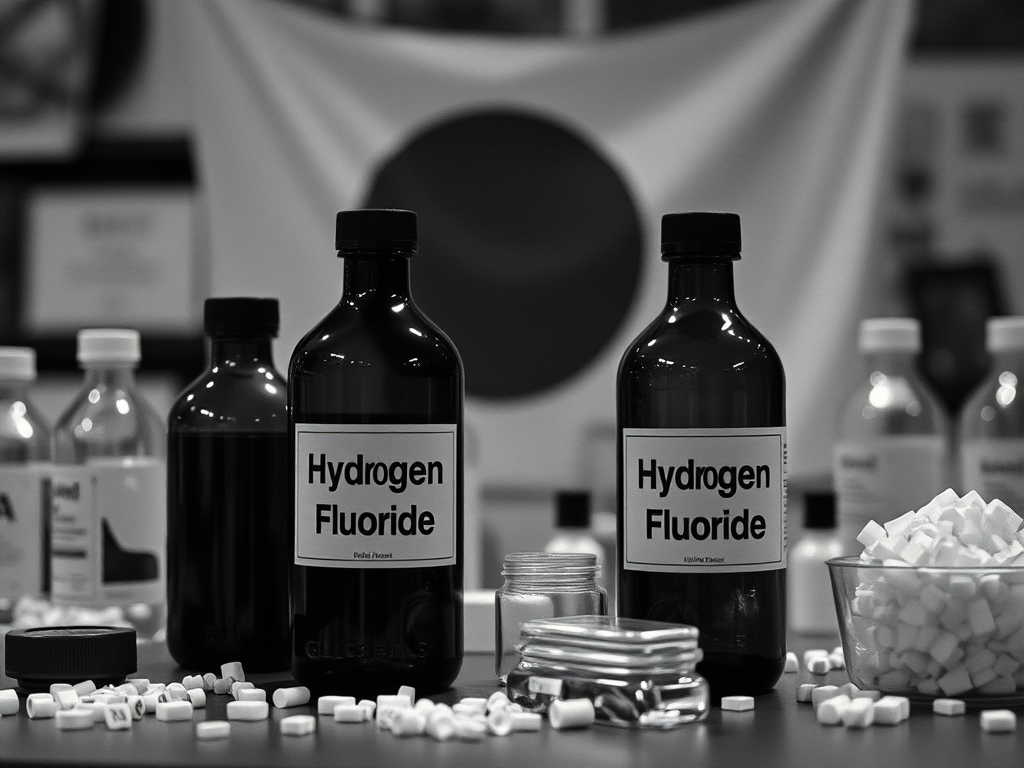
Japan announces export controls on chemicals to South Korea in July 2019, and in August 2019 removes South Korea from its hi-tech export whitelist.
Context
In July 2019, Japan announced controls on the export of three chemicals to South Korea: hydrogen fluoride, photoresists, and fluorinated polyimides. Japan’s measures targeted major South Korean smartphone and semiconductor firms, who had previously relied on Japanese exports as a source of some components. Japan placed controls on the export of three chemicals (hydrogen fluoride, photoresists, and fluorinated polyimides) to South Korea.
Then, on August 28, 2019, the Japanese government formally removed South Korea from a “white list” of states that receive fast-track treatment as approved destinations for Japan’s hi-tech exports that have dual use potential. South Korea had previously been a member of this list since 2004. This change in policy was signed off by the Japanese cabinet on August 2.
The formally stated reason for this move was national security concerns. The Japanese government claimed that South Korea was not fulfilling its obligations to prevent the resale of strategic goods to geopolitically threatening states e.g. North Korea.
However, these measures were widely believed to be principally related to historical disputes dating back to Japanese colonial era rule over Korea, and specifically the decision by South Korean courts to award compensation to forced labourers from Japanese firms angered the Japanese government.
Impact
One report claimed that around 1,120 products could be impacted by delisting South Korea, ranging from “materials and equipment that could have military use; chemicals such as fluorinated polyimide, photoresists and hydrogen fluoride used in chip manufacturing; chip-making parts; machines and equipment; integrated circuits; capacitors; adhesives for flat panel displays; ball bearings; and industrial robots.”
Analysis of trade data from early 2020 showed that “South Korean exports to Japan were down 6.9 percent, while imports from Japan were down 12.9 percent. However, both exports to and imports from Japan were already on a declining trend in the first half of 2019, before the tit-for-tat trade restrictions.” Therefore, the impact of these measures can be said to be limited.
Responses
i) South Korean Industry
South Korean industry made few public comments, possibly out of fear of further destabilising trade relations.
(ii) South Korean Consumers
South Korean consumers responded with a widespread boycott of Japanese products.
(iii) South Korean Government
In August 2019, the South Korean government announced a US$6.48 billion fund for research and development to cut reliance on Japanese imports over a seven year period.
South Korea also responded by making its own list of states that don’t conform to international norms on export controls – with Japan the first state named. It also announced its intention to withdraw from GSOMIA (General Security of Military Information Agreement) – a bilateral intelligence sharing pact with Japan.
Additionally, South Korea initiated a WTO complaint, requesting formal consultations in September 2019 and the subsequent establishment of a panel in July 2020. Relevant WTO documentation is available here.
(iv) Other Parties
The United States was concerned about this conflict between its two core allies in Northeast Asia. It applied pressure to both sides to resolve the conflict, and praised steps taken to resolve the conflict.
Status
After his election in 2022, new South Korean President Yoon Suk-yeol placed importance on improving South Korea-Japan ties. Incremental progress led to a full resolution of the conflict in early-mid 2023 – with South Korea and Japan announcing the restoration of each other to trade whitelists, South Korea withdrawing its complaint from the WTO, and the normalisation of the GSOMIA intelligence sharing pact.
References & Further Information
Borowiec, S. 2023. “Japan lifts final South Korea trade restriction.” Nikkei Asia. June 27. Available at: https://asia.nikkei.com/Politics/Japan-South-Korea-ties/Japan-lifts-final-South-Korea-trade-restriction
Cha, V. 2019. “The Meaning of GSOMIA Termination: Escalation of the Japan-Korea Dispute.” CSIS. August 22. Available at: https://www.csis.org/analysis/meaning-gsomia-termination-escalation-japan-korea-dispute
Clark, C. (2023). “South Korea and Japan resume intel sharing agreement, but not all problems are solved.” Breaking Defense. April 17. Available at: https:// breakingdefense.com/2023/04/south-korea-and-japan-resume-intel-sharing-agreement-but-not-all-problems-are-solved/
Ho, D. 2019. “Why South Korea is no longer on Japan’s approved export list.” Al Jazeera. August 28. Available at: https://www.aljazeera.com/economy/2019/8/28/why-south-korea-is-no-longer-on-japans-approved-export-list
Jin, H.J. 2019. “South Korea to spend $6.5 billion on R&D to cut reliance on Japanese imports.” Reuters. August 5. Available at: https://www.reuters.com/article/us-southkorea-japan-laborers-ministry/south-korea-to-spend-6-5-billion-on-rd-to-cut-reliance-on-japanese-imports-idUSKCN1UV00M/
Kyodo News. 2019. “Japan to remove South Korea from preferential treatment list.” Kyodo News. July 26. Available at: https://english.kyodonews.net/news/ 2019/07/d18488a1b80c-breaking-news-japan-to-drop-s-korea-from-list-of-favored-nation-trade-partners.html
Lee, D.W. 2022. “The Inauguration of the Yoon Suk-yeol Government and Prospects for South Korea–Japan Relations.” Asia-Pacific Review 29 (3) 151-174.
Shin, H.H. and Choi, S.H. (2023). “South Korea’s Yoon says Japan will return to trade ‘white list’.” Reuters. March 21. Available at: https://www.reuters.com/world/asia-pacific/south-koreas-yoon-says-he-will-order-japan-back-trade-white-list-2023-03-21/
Smith, J., Choi, S.H., and Murakami, S. (2023). “South Korea companies to pay to resolve forced labour dispute with Japan.” Reuters. March 7. Available at: https://www.reuters.com/world/asia-pacific/south-korea-announce-plans-resolve-forced-labour-dispute-with-japan-2023-03-06/
Stangarone, T. 2020. “Parsing the Economic Damage From the Japan-South Korea Dispute.” The Diplomat. January 24. Available at: https://thediplomat.com/ 2020/01/parsing-the-economic-damage-from-the-japan-south-korea-dispute/
Todo, Y. 2020. “The fallout from the Japan–South Korea trade ruckus on global trade rules.” Australia-Japan Research Centre, Australian National University. 8 (1) 2020. Available at: https://ajrc.crawford.anu.edu.au/department-news/15892/fallout-japan-south-korea-trade-ruckus-global-trade-rules
VOA. 2019. “South Korea Removes Japan from Fast-Track Trade List.” VOA. September 18. Available at: https://www.voanews.com/a/east-asia-pacific_south-korea-removes-japan-fast-track-trade-list/6176022.html
WTO. 2023. “Korea withdraws WTO dispute complaint regarding Japanese export measures.” WTO. March 24. Available at: https://www.wto.org/english/ news_e/news23_e/disp_24mar23_e.htm