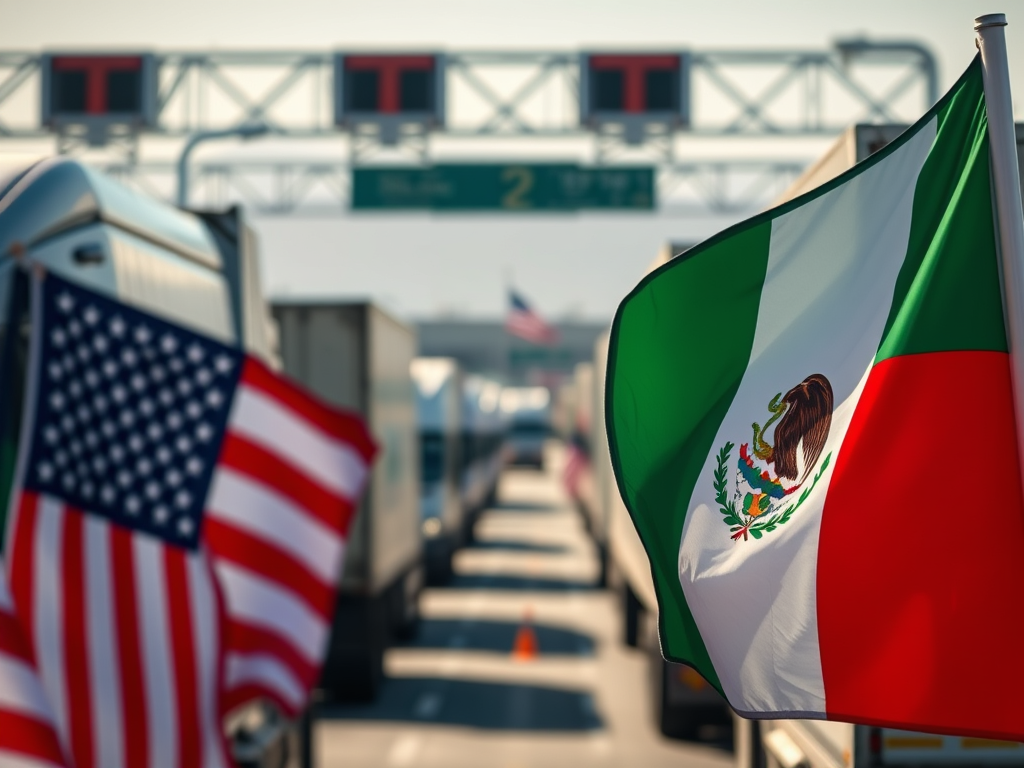
US announces intention to impose tariffs on Mexican imports in May 2019.
Context
In May 2019 US President Donald Trump stated that the US would impose new tariffs on all US imports from Mexico, unless the Mexican government took decisive action to end the flow of undocumented migrants across the border. President Trump’s statement claimed that the tariffs, which would particularly impact automobile imports, would entail 5% from June 10, and 25% by October 1, but also noted that “[i]f the illegal migration crisis is alleviated through effective actions taken by Mexico, to be determined in our sole discretion and judgment, the tariffs will be removed”. This announcement came in the context of what US politicians have referred to as a ”humanitarian crisis” on the US-Mexico border due to the alleged high volume of undocumented border crossings.
Impact
In response to President Trump’s initial policy announcement, share prices fell in the global automaking supply chain, including firms such as Mazda, Volkswagen, and General Motors. Despite these tariffs being called off shortly before they were due to be implemented, reports have suggested that the announcement nevertheless heightened uncertainty and risk in affected industries.
Responses
(i) Mexican government and industry responses.
Mexican President Andres Manuel Lopez Obrador responded to President Trump’s original statement through his own public letter, in which he did not threaten retaliation, but instead stated that “social problems are not resolved with taxes or coercive measures” and said that the Mexican foreign minister, Marcelo Ebrard, would lead a diplomatic delegation to Washington DC to engage in representations. Subsequently, President Lopez Obrador told reporters that “I tell all Mexicans to have faith, we will overcome this attitude of the U.S. government, they will make rectifications because the Mexican people don’t deserve to be treated in the way being attempted”.
In early June 2019, the Mexican and US governments entered discussions on the migration issue for a deal to avert the tariffs. The two governments reached an agreement with a June 7 joint declaration in which the Mexican Government agreed to “take unprecedented steps to-increase enforcement to curb irregular migration, to include the deployment of its National Guard throughout Mexico, giving priority to its southern border.” In response, President Trump Tweeted that “[t]he Tariffs scheduled to be implemented by the U.S. on Monday, against Mexico, are hereby indefinitely suspended. Mexico, in turn, has agreed to take strong measures to… stem the tide of Migration through Mexico, and to our Southern Border.”
(ii) US government and industry responses
The US Chamber of Commerce announced its opposition to President Trump’s announced mechanism, with Executive Vice President and Chief Policy Office Neil Bradley telling press “[w]e have no choice but to pursue every option available to push back.” Meanwhile, the acting head of the Alliance of Automobile Manufacturers (a trade group that represents major US automobile firms), David Schwietert, said that “[a]ny barrier to the flow of commerce across the U.S.-Mexico border will have a cascading effect – harming U.S. consumers, threatening American jobs and investment.”
The US Government responded to these criticisms by calling upon US firms to ask their Mexican partner firms to put pressure on the Mexican Government to concede to US demands, with US Government spokesperson Judd Dere saying “[i]ndustry should be in communication with their counterparts in Mexico to encourage the Mexican government to work with the administration and stave off the dangerous crisis at our southern border as quickly as possible.”
(ii) Other state and industry responses
Chinese foreign ministry spokesperson Geng Shuang told press that “The United States has repeatedly taken trade bullying action. China is not the only victim”. Deutsche Bank’s Emmanuel Rosser claimed that the proposed tariffs “could cripple the [automotive] industry”.
Status
These measures were cancelled prior to enforcement, in June 2019. However, as of October 2024 former president and current Presidential Candidate Trump has recently called for the US to “put a tariff of 200% on if we have to” on Mexico-produced automobiles as part of efforts to support the US’ domestic automobile industry.
7. Key takeaways?
Example of threat of weaponised trade that was not ultimately carried out, but still had, and has, important consequences.
Reference list
Bredemeier, K. 2019. “As Tariff Threat Looms, US, Mexico Discuss Migration.” VOA. June 7. Available at: https://www.voanews.com/a/as-tariff-threat-looms-us-mexico-discuss-migration/4949580.html
Department of State. 2019. “Joint Declaration and Supplementary Agreement Between the UNITED STATES OF AMERICA and MEXICO.” Department of State. June 7. Available at: https://www.state.gov/wp-content/uploads/2019/09/19-607-Mexico-Migration-and-Refugees.pdf
Holland, S. and Daniel, F.J. 2019. “Trump vows rapid, high tariffs on Mexico unless illegal immigration ends.” Reuters. May 31. Available at: https://www.reuters.com/article/ world/trump-vows-rapid-high-tariffs-on-mexico-unless-illegal-immigration-ends-idUSKCN1T01GP/
Law, T. 2019. “As Trump Suspends New Tariffs on Mexico, Experts Warn That His Threats Could Damage the U.S. Economy.” Time. June 8. Available at: https://time.com/ 5603489/tariffs-mexico-concern-threat-trump/
Tajitsu, N. and Prodhan, G. 2019. “Trump’s Mexican tariffs threaten to disrupt auto sector.” Reuters. June 1. Available at:https://www.reuters.com/article/business/trumps-mexican-tariffs-threaten-to-disrupt-auto-sector-idUSKCN1T11TW/
Trump, D. 2019. Tweet. Twitter. June 8. Available at: https://x.com/realDonaldTrump/ status/1137155056044826626