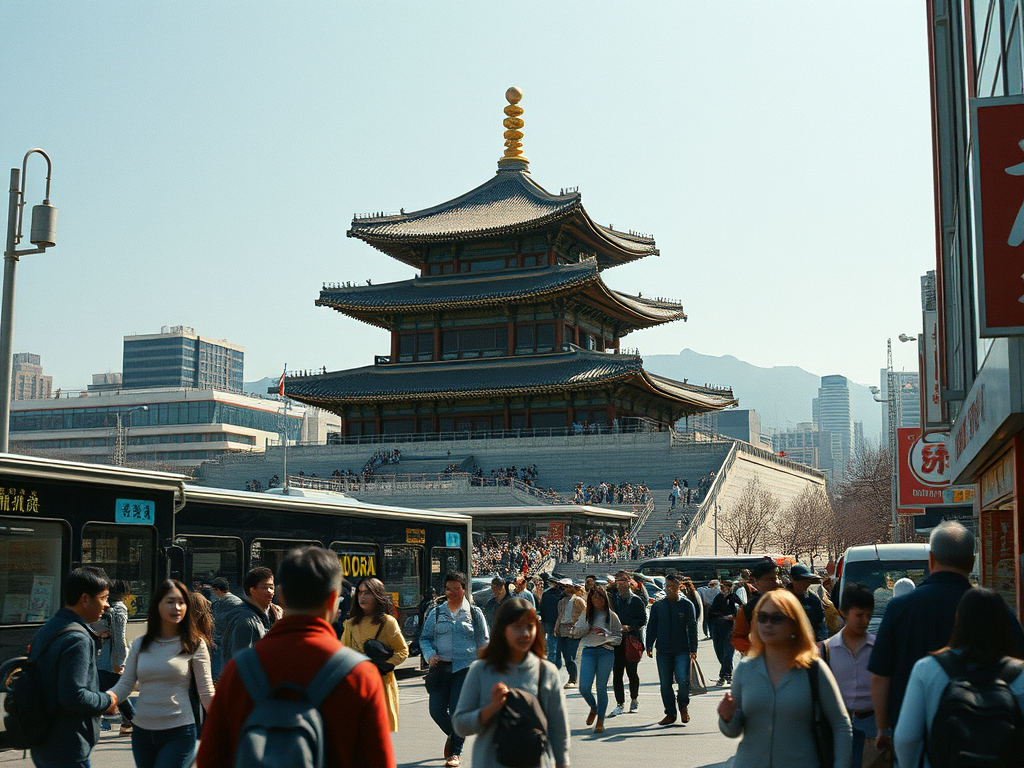
China imposes limits on tourism to South Korea in March 2017.
Context
In March 2017 it was reported that Chinese authorities were informally requiring Chinese travel agencies to heavily restrict tourism into South Korea – including by ending group tours. News reports of these unofficial bans continued throughout 2017.
The Chinese government had denied the existence of these informal bans. When the issue was raised by South Korean reporters, the Chinese Ministry of Affairs spokesperson denied hearing any information on the measures. He further emphasised that the Chinese government had continuously encouraged outbound tourism, but that both countries had to respect the will of the people. This statement implied that the decline of tourism was caused by the free choice of Chinese travellers.
The crucial political context here was South Korea’s July 2016 decision to install a battery of the US’ Terminal High Altitude Area Defense (THAAD) system. The US and South Korea claimed that THAAD was wholly focused on tackling the North Korea threat, but Beijing claimed that THAAD’s radar system could be used to monitor deep into Chinese territory. Notably, the specific timing of this move came shortly after a February 2017 formal land swap agreement between South Korean conglomerate Lotte Group and the South Korean government – which provided the site for the THAAD deployment – further angering Beijing.
Impact
This measure impacted businesses ranging from duty-free shops, hospitals, casinos, hotel chains, and medical services (e.g. plastic surgery clinics). From 2013-2016 China was the number one source of foreign tourists to South Korea. In 2016 alone tourism from Korea to China rose by 32%. One analysis concludes that tourism was “the industry most affected” by China’s reaction to the THAAD dispute.
Although China officially denied imposing restrictions, Korean government data on Chinese visitors to South Korea from 2016 to 2019 highlights a significant decline in March 2017, with the number of Chinese visitors dropping from 590,790 in February to 360,782 in March. As shown in the graph below, the share of visitor arrivals from Mainland China to South Korea significantly decreased from 2017.

Responses
i) South Korean government and industry responses.
One unnamed official from South Korea’s Naeil Tour Agency told press in December 2017 that “I was told from my boss this morning that our Chinese partners (based in Beijing and Shandong) said they won’t send group tourists to South Korea as of January (2018).” Korean firms largely did not respond publicly to the news, but it is thought that attempts were made to promote diversification as a general response to these and other THAAD-linked measures.
In October 2017, a bilateral agreement was reached in which both sides agreed to move beyond the dispute. As noted below, the incoming Moon administration sought engagement with Beijing on the issue and ultimately made a series of diplomatic concessions voluntarily placing limits on South Korea’s integration into the US’ military system.
Status
The number of Chinese tourists visiting South Korea began to rise in 2018. This followed an improvement in bilateral relations in late 2017, when the incoming Moon administration in 2017 moved to establish Seoul’s so-called ‘Three No’s’ policy: no additional THAAD batteries, no joining the US’ missile defense network, and no making a trilateral military alliance with Tokyo and Washington D.C. These measures were fully lifted in August 2023, as part of a broader relaxation of travel rules following the end of COVID-19 restrictions.
There were multiple reports in March 2017 that South Korea had complained to the WTO around this dispute, but it does not appear that Seoul ever went as far as to formally request consultations.
Reference list
BBC News. 2017. “S Korea complains to WTO about China over Thaad.” BBC News. March 20. Available at: https://www.bbc.com/news/business-39324536
Huang, E. 2017. “China is trying to punish South Korea by keeping its tourists away.” Quartz. March 3. Available at: https://qz.com/923890/china-retaliates-against-thaad-antimissile-system-and-bans-tourism-to-south-korea
Kim, C. and J. Chung. 2017. “South Korea complains to WTO over China response to missile system.” Reuters. March 20. Available at: https://www.reuters.com/article/ world/south-korea-complains-to-wto-over-china-response-to-missile-system-idUSKBN16R03D/
Kim, D.H. 2017. “South Korean inbound travel agency says China bans group tours to South.” Reuters. December 20. Available at: https://www.reuters.com/article/world/ south-korean-inbound-travel-agency-says-china-bans-group-tours-to-south-idUSKBN1EE0BP/
Korean Statistical Information Service. ‘Korean Tourism Statistics (2003-2021): Visitors Arrivals – by purpose/by nationality’. Available at: https://kosis.kr/statHtml/statHtml.do?orgId=314&tblId=DT_TGT_ENT_AGG_MONTH&vw_cd=MT_ETITLE&list_id=H2_19&scrId=&seqNo=&language=en&obj_var_id=&itm_id=&conn_path=A6&path=%252Feng%252Fsearch%252FsearchList.do.
Lee, H.R. 2023. “China allows group tours to Korea after more than 6 years of restrictions.” The Korea Times. August 10. Available at: https://www.koreatimes.co.kr/ www/culture/2024/09/135_356802.html
Lim, D. and V. Ferguson. 2019. “Chinese Economic Coercion during the THAAD Dispute.” The Asan Forum. December 28. Available at: https://theasanforum.org/ chinese-economic-coercion-during-the-thaad-dispute/
Lu, J. 2017. “ANALYSIS: Effects of the ban on China-South Korea group tours.” FlightGlobal. May 16. Available at: https://www.flightglobal.com/analysis/analysis-effects-of-the-ban-on-china-south-korea-group-tours/123875.article
Ministry of Foreign Affairs of the People’s Republic of China. 2016. ‘Foreign Ministry Spokesperson Lu Kang hosted regular press conference on 26 October 2016’ [2016年10月26日外交部发言人陆慷主持例行记者会] October 26. Available at: http://lk.china-embassy.gov.cn/fyrth/201610/t20161026_1489346.htm.
Park, B.S. 2017. “South Korea’s “three no’s” announcement key to restoring relations with China.” Hankyoreh. November 2. Available at: https://english.hani.co.kr/arti/ english_edition/e_international/817213.html
Park, H.N. 2023. “How will China’s lifting of group travel ban affect Korea’s GDP?” The Korea Herald. August 25. Available at: https://www.koreaherald.com/ view.php?ud=20230825000553
Reuters. 2018. “Chinese tourists returning to South Korea after missile tensions cool.” South China Morning Post. May 2. Available at: https://www.scmp.com/news/china/ diplomacy-defence/article/2144327/chinese-tourists-returning-south-korea-after-missile
Statista. 2020. ‘Share of visitor arrivals from Mainland China to South Korea from 2009 to 2019’ July. Available at: https://www.statista.com/statistics/1053544/south-korea-visitor-arrivals-from-mainland-china-share/.
Wang, R. 2024. “Reality Check: South Korea and China Face More Complex Economic Dynamics.” The Diplomat. June 15. Available at: https://thediplomat.com/2024/06/ reality-check-south-korea-and-china-face-more-complex-economic-dynamics/